

Question 1
Google Drive Folder Hierarchy Sync
In the Google Drive architecture, a folder hierarchy is maintained where folders can be nested within one another, folders 1 to n. Each folder has a specific access level, represented by an integer.
A hierarchy is considered "Synced" when the absolute difference between the access levels of any two directly connected folders, a parent and its child, is at most 1.
Due to a recent update, some folders have had their access levels changed. To maintain security integrity and ensure the hierarchy is "Synced", you must increase the access levels of other folders.
Your goal is to find the minimum total increase in access levels required to make the entire folder hierarchy "Synced".
Note: You can only increase access levels; you cannot decrease them.
Example
Consider the following hierarchy tree:
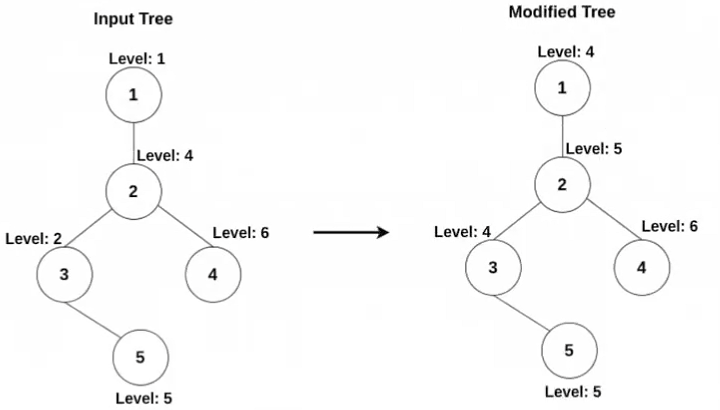
The optimal way to sync it is:
- Increase
2access levels of folder3 - Increase
1access level of folder2 - Increase
3access levels of folder1
After these additions, the hierarchy tree becomes synced, and the minimum number of access level increase required is:
2 + 1 + 3 = 6Function Description
Complete the function findMinIncrease in the editor with the following parameters:
int tree_nodes: the total number of folders in the hierarchy tree
int tree_from[tree_nodes - 1]: one end of each edge
int tree_to[tree_nodes - 1]: the other end of each edge
int access_levels[tree_nodes]: the access level of each folder
Returns
long: the minimum number of access level increase required to sync the hierarchy treeConstraints
1 ≤ tree_nodes ≤ 2 * 10^5
0 ≤ access_levels[i] ≤ 10^9
Sample Case 0
Sample Input For Custom Testing
STDIN        FUNCTION
-----        --------
5 4      ->  tree_nodes = 5, m = 4
1 2      ->  tree_from = [1, 2, 2, 3], tree_to = [2, 3, 4, 5]
2 3
2 4
3 5
5        ->  access_levels[] size tree_nodes = 5
1        ->  access_levels[] = [1, 5, 7, 8, 3]
5
7
8
3
Sample Output
10Explanation
Following are the optimal changes that will make the given hierarchy tree synced using minimum increase of access levels:
- Increase
2access levels for folder2 - Increase
5access levels for folder1 - Increase
3access levels for folder5
After performing the above 3 operations, the hierarchy tree is synced. Access levels increased:
2 + 5 + 3 = 10Question 2
Google Docs Mobile Feature Rollout
Google Docs rolls out new mobile features gradually. A feature can only be enabled for a user if:
- The user meets basic eligibility requirements such as supported country and minimum OS version.
- All required feature dependencies are satisfied.
Some features depend on other features. A feature must not be enabled unless all of its dependencies are enabled first, either because they were already enabled or because they are also being enabled in the same rollout request.
The current rollout script is buggy. It enables features for ineligible users and ignores dependency constraints.
Your task is to fix this behavior.
For each user and each requested feature, determine whether the feature should be enabled.
For every decision, return a clear and correct reason when a feature cannot be enabled.
Inputs
Feature dependency definitions
File:
data/features.txtEach line defines a feature and its dependencies.
Format:
A -> B means feature A depends on feature B
A -> B,C means feature A depends on features B and C
D means feature D has no dependencies
Dependencies are strict. All listed dependencies must be satisfied.
Users to evaluate
Input file:
data/users.jsonlFormat:
one JSON object per lineEach user record includes:
- User identifiers and platform details
- A list of features already enabled for the user
- A list of features requested in the current rollout
Example:
{"user_id":"u1","country":"US","platform":"ANDROID","android_version":12,"enabled_features":["C","D"],"feature_requests":["A","B"]}
{"user_id":"u2","country":"IN","platform":"ANDROID","android_version":12,"enabled_features":[],"feature_requests":["B"]}
{"user_id":"u3","country":"FR","platform":"IOS","ios_version":16,"enabled_features":["C"],"feature_requests":["A"]}
Output
File:
data/results.jsonlOutput one JSON object per input user, in the same order.
Each output object must include:
user_idresults: an array with one entry per requested feature
Output rules:
If a feature is enabled, return:
{"feature":"<name>","enabled":true}If a feature is disabled, include a reason field:
{"feature":"<name>","enabled":false,"reason":"<REASON_CODE>"}Example:
{"user_id":"u1","results":[{"feature":"A","enabled":false,"reason":"DEPENDENCY_NOT_ENABLED:B"}]}Decision Logic and Evaluation Order
Feature evaluation must follow the rules below in strict order.
Once a rule blocks a feature, no further checks should be applied.
Step 1: Basic user eligibility
These checks apply to all requested features.
Supported countries
Allowed countries:
US
IN
ES
If the user’s country is not supported:
Reason: COUNTRY_NOT_SUPPORTEDMinimum OS version
For Android:
- Minimum supported version is Android
10 - If not met, reason:
ANDROID_TOO_OLDFor iOS:
- Minimum supported version is iOS
15 - If not met, reason:
IOS_TOO_OLDIf both country and OS checks fail:
Reason: COUNTRY_AND_OS_NOT_SUPPORTEDOnly if all eligibility checks pass, should dependency evaluation begin.
Step 2: Feature dependency checks
A requested feature can be enabled only if all of its dependencies satisfy one of the following:
- The dependency is already present in
enabled_features - The dependency is also present in
feature_requestsand can be enabled in the same evaluation batch
Important constraints:
- The system must not automatically enable dependencies that were not explicitly requested.
- Dependency checks must be recursive.
- Dependencies must be enabled in the correct order.
If a required dependency is not enabled:
- Disable the feature
- Reason format:
DEPENDENCY_NOT_ENABLED:<dependency_name>- Report the first missing dependency encountered.
Example:
- If
Adepends onBandBdepends onC:Cmust be enabled beforeBBmust be enabled beforeA
Cycle handling
If the dependency graph contains a cycle, the affected feature can never be enabled.
Example:
Adepends onBBdepends onA
In this case:
- Disable the feature
- Reason:
CYCLE_DETECTED我们也有代面试,面试辅助,OA代写等服务助您早日上岸~